AEO Mutual Recognition Arrangements (MRAs)
AEO Mutual Recognition Arrangements (MRAs) enable two Customs administrations to recognise the compatibility of their respective AEO or trusted-trader programmes and to extend reciprocal facilitation to eligible operators, in accordance with the scope and operational procedures agreed under each arrangement. Through an operational MRA, eligible AEO shipments may receive risk-based facilitation in the partner country, supporting more predictable and efficient cross-border movement.
AEO status is recognised by partner Customs administrations.
Recognition supports risk-based facilitation and fewer interventions.
Validation efforts can be recognised by partner administrations.
Trusted operators gain improved cargo movement and planning confidence.
What MRAs support
Reduced inspections
Lower intervention rates at partner ports through risk-based recognition.
Faster release
Improved clearance predictability for eligible AEO shipments.
Mutual confidence
Security and compliance standards are recognised across programmes.
Lower delays
Smoother cross-border movement and reduced uncertainty for trusted trade.
What is an MRA?
An AEO Mutual Recognition Arrangement is an understanding between two Customs administrations under which they recognise the compatibility of their respective AEO or trusted-trader programmes and agree on reciprocal facilitation measures for eligible operators.
OVERVIEW
Three-step view
The entity demonstrates compliance and supply-chain security standards.
Recognition is based on compatibility, confidence, and agreed procedures.
Benefits may include lower risk scores, fewer checks, and faster release, subject to partner procedures.
Benefits of MRA for AEOs
Operational MRAs extend the value of AEO certification beyond national borders by enabling eligible operators to receive reciprocal, risk-based facilitation in partner countries.
Lower risk score
AEOs are recognised as trusted members of the trade community, which can translate into fewer examinations at partner borders.
Risk assessment support
The status of an MRA partner’s AEO participant can be recognised and used as a risk-assessment factor.
Less duplication
Initial validation by the local Customs administration may be recognised by partner administrations.
Common standards
MRAs promote comparable security criteria and strengthen documentation, compliance and self-assessment culture.
Transparency
Closer cooperation among Customs administrations and AEOs improves information sharing and trade facilitation.
Predictable trade flows
Fewer unexpected delays support better shipment planning, stronger buyer confidence and resilient supply chains.
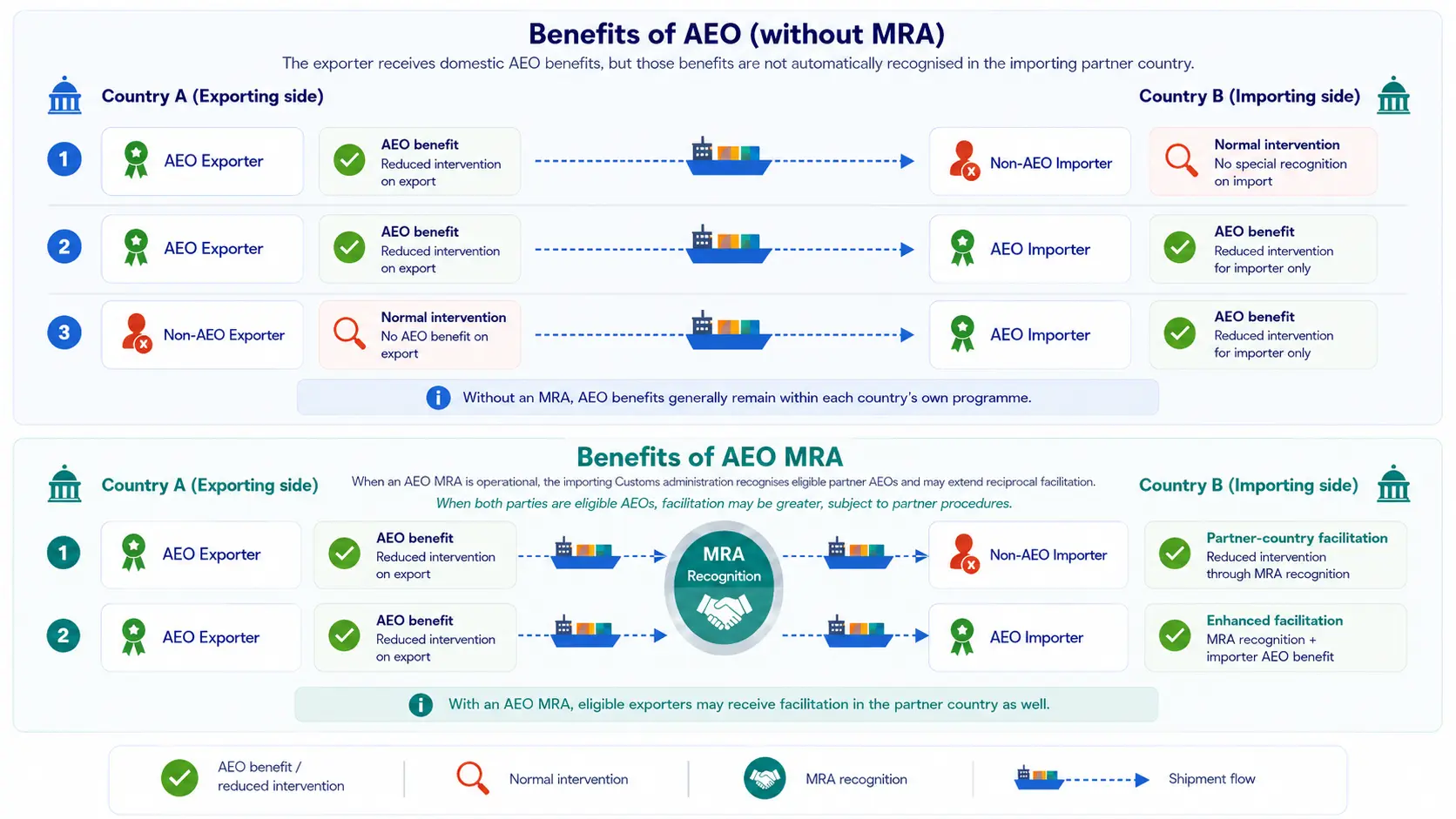
How an AEO MRA supports trusted trade
A simplified illustration of how mutual recognition can support secure, predictable and facilitated trade between partner countries.
India’s operational AEO MRAs
Hong Kong
Date of Signing 28.11.2013
South Korea
Date of Signing 08.10.2015
Taiwan
Date of Signing 18.12.2018
USA
Date of Signing 22.09.2021
UAE
Date of Signing 22.06.2023
Australia
Date of Signing 18.04.2024
Russia
Date of Signing 15.05.2024
Japan
Date of Signing 24.12.2024
New Zealand
Date of Signing 17.03.2025
Singapore
Date of Signing 20.05.2025
South Africa
Date of Signing 26.06.2025
Operational guidance
Operational guidance for Indian importers: Where prescribed, an Indian importer may request generation of an Overseas Business Identification Number (OBIN) for an eligible AEO supplier located in an MRA partner country.
Frequently asked questions
Common questions about Mutual Recognition Arrangements and their benefits for AEO-certified operators.